
Chitwan: Where The Jungle Calms The Heart (A Solo Traveler’s Love Story)

Chitwan does that the second you step off the bus. The air turns warmer, thicker — like the jungle wants to hug you whether you agreed or not. People say Chitwan means “Heart of the Jungle.” I swear I could feel a heartbeat under my feet.
I wasn’t here for a checklist. I was here to listen. To the river. To the grass. To the version of me that’s braver when the world is green.
Chitwan National Park just can not be missed.
? Need to Know: Chitwan
When to go
Best overall: October–March for cooler temps & clearer wildlife viewing. April–May is hotter but sightings can be active. Monsoon (June–September) is lush yet muddy with limited visibility.
How to go
✈️ Fly Kathmandu → Bharatpur (BHR) (~25 min), then taxi ~16–18 km to Sauraha (park hub).
? Tourist bus/private car via East–West Highway (~5–6 hours), scenic and simple.
Best budget place to stay
In Sauraha (outside the park): reliable budget picks include Hotel Parkside and Jungle Safari Lodge. For mid-range with Tharu design and social impact, try Sapana Village Lodge.
How long to stay
Minimum 3 nights: one sunrise safari, one canoe + jungle walk day, one village/cycling/sunset day. Add a 4th to linger.
What I loved most
The hush of the Rapti at dawn — and that moment a rhino decided we were boring and went back to being magnificent.
My one-word description
Grounding
The Hum of Sauraha & My First Breath of “Slow”
Sauraha is the main hub at the park’s edge — dusty lanes, reggae drifting from cafés, carved wooden rhinos in shop windows, locals who smile first and ask questions later. A tractor rolled past a coffee stall; schoolkids in crisp uniforms tried to sneak an extra samosa; a rooster somewhere ran the neighborhood like a middle manager on a mission.
I checked into a bamboo-porch lodge where a sleepy dog guarded the doorway like an expert in doing nothing. The owner pressed cold juice into my hand and said, “Here, we do everything slowly-slowly.” The official motto of Nepal’s jungle — and the reset I didn’t know I needed.
I spent my first hour doing something the city never lets me do: nothing. Feet up on the railing. Watching a man pedal by with a stack of aluminum pots balanced like a shiny wedding cake. Breathing until my shoulders remembered they have a “down” setting.
As dusk crept in, I walked to the riverside. Tourists gathered at the wall, camera straps crisscrossing like bandoliers; locals leaned against their motorbikes, trading theories about the weather. The Rapti carried the last of the light like it had been hired for the job. Someone started strumming a guitar. Someone else announced they’d seen a croc “this big.” Chitwan is nothing if not social science for storytellers.
Safari Morning — Wind, Wild Eyes & My Heart Pounding Like Hooves
At sunrise, the forest is still stretching. Mist hangs low, animals haven’t decided whether to hide yet, and the world feels possible. We climbed into an open jeep and let the breeze undo our city thoughts. The driver touched the horn twice as if to say, “Good morning, universe. Kindly move any elephants.”
Chitwan unrolled around us: elephant grass whispering against the sides of the vehicle, dew bright on leaves, a spotted deer peeking through a bush like, “Oh hello, travelers.” Rhesus monkeys traded gossip in the trees; a peacock burst from the grass like blue fire; an owlet supervised us with serious baby-bird eyes. The guide spoke in gentle paragraphs — how the sal forest feeds the ecosystem; how the river rewrites the park every monsoon; how patience is the first skill a safari teaches.
Then our guide raised his hand. A pause. A point. Everyone learned how loud breathing can be when you’re trying to be quiet.
A one-horned rhino. Massive. Ancient. Unapologetically confident. He looked like the jungle shaped itself into armor and walked out to see who was visiting. He flicked an ear, considered us, decided we were boring, and carried on with the kind of dignity that makes you examine your own posture.
Farther in, we stopped to read a patch of ground the way you read a plot twist. Prints. Fresh. Tiger? The guide squinted like a detective who knows too much. “Too old,” he said, smiling — and we exhaled as if danger had been a rumor we didn’t start.
We looped across sandy channels, past termite palaces and egrets that behaved like they owned the sunlight. The jeep rattled. My grin didn’t. Back at the lodge, breakfast tasted like a reward — eggs, toast, and tea that could talk you into good decisions.
Canoe Glide — The Art of Moving Without Disturbing
A dug-out canoe is a tree that decided to become a boat. We carried it to the river like pallbearers at a ceremony where the only thing being laid to rest was hurry. The Rapti was flat as polished stone, the color of green tea poured by a generous hand.
“Look,” whispered our guide. Crocodile eyes. Just the eyes. Watching us pass. We watched back, learning the etiquette of not being in charge. Kingfishers dove like blue arrows; herons posed for Wetlands Vogue; a pied wagtail performed its tiny runway strut on a sandbar. The paddle barely sighed. It felt like we were being taught the river’s manners.
Halfway along, the silence developed texture: the thrum of insects, the elastic plop of something aquatic with dreams, the wind threading itself through elephant grass. I felt cities loosening their grip on my lungs. Nobody told me to meditate. The river did it for me.
Jungle Walk — Fear Has a Scent (So Does Freedom)
We stepped ashore and followed our guide into the forest: no armor, no engine — just boots, curiosity, and someone who could identify a rustle by mood. He taught us to watch for fresh dung (wildlife news bulletins), to read claw marks on trunks (territorial tweets), and to notice when the birds fall silent (the jungle holding its breath).
We crossed prints that looked like someone had pressed a giant flower into the mud — rhino. We crossed another that was pure geometry — deer. We crossed a third that made my stomach pay attention — big cat, but old. “Relax,” said the guide, which is a hilarious instruction when your DNA remembers being prey.
Spiderwebs big enough to file paperwork. Butterflies like living confetti. Humidity at 100%; dignity at 37%. A soft splash at a bend — a rhino bathing, Tuesday spa appointment. We watched his ears make tiny decisions. He watched us fail to be invisible.
Then a crack of branches. A stillness with edges. The guide motioned us behind a tree: stay. A wild elephant appeared, tusks lit by sun, opinionated and gorgeous. My pulse learned a drum solo. He sniffed the air as if deciding whether we were nonsense or trouble, judged us harmless, and drifted back into green like a rumor with legs.
Relieved laughter tastes sweeter than dessert. “That,” our guide grinned, “is why slowly-slowly is smart.” On the way back, we hopped creeks, balanced on logs, and discovered that courage and clumsiness are compatible travel buddies.
Elephant Encounters — Love Means Freedom
People picture elephants with tourists on their backs. We’re learning better. In Chitwan — as everywhere — love means dignity and space.
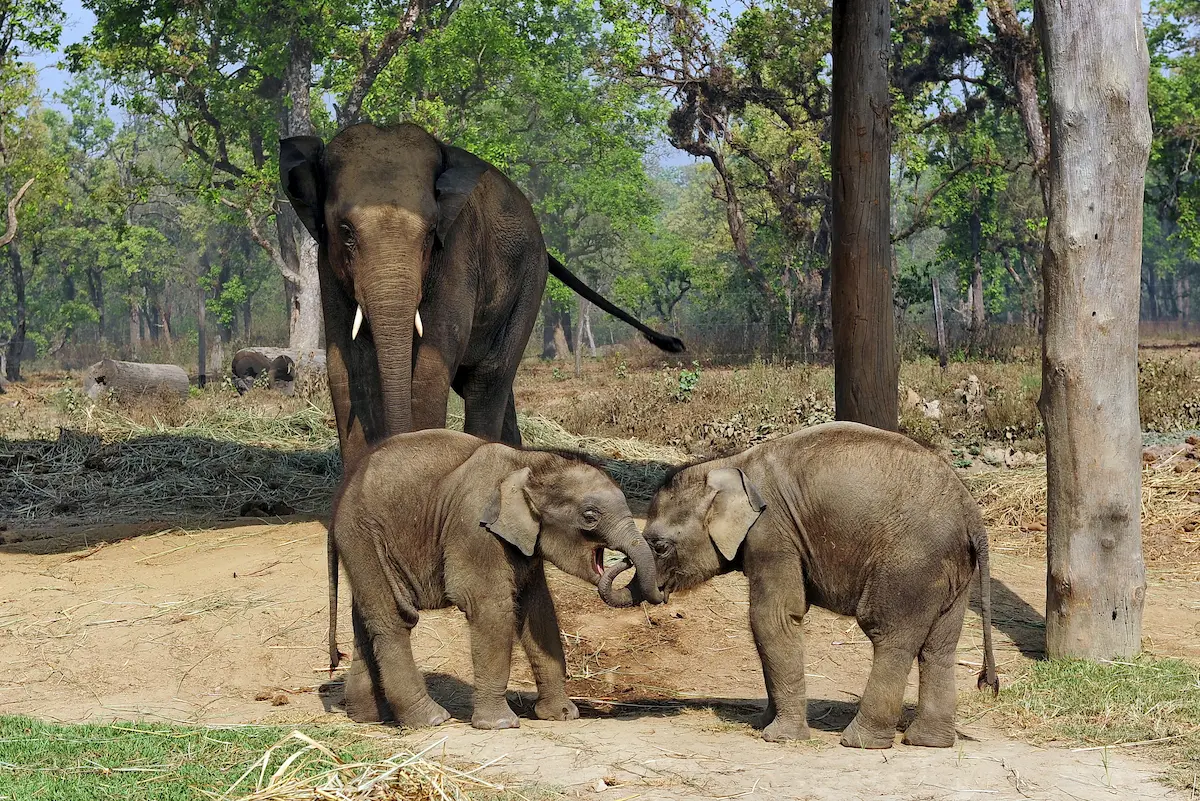
At the Elephant Breeding Centre, mothers and calves wandered in wide paddocks. A calf flung dust like glitter; another splashed itself silly. Rangers spoke about mahouts, about shifting traditions, about how protecting habitat is the long game. I listened with my whole chest. I’ve ridden elephants in the past because I didn’t know better. Now I do. And knowing better is a privilege that comes with choices.
We offered bundled snacks and kept respectful distance. Every time a trunk reached toward me, it felt like forgiveness. I didn’t need the photo-op on a saddle. I needed to be the kind of traveler my future self is proud of.
Love does not sit on someone else’s spine.
Tharu Evenings — Drums at Dusk & Mud Art at Noon
The Tharu people have lived here for centuries — guardians of these plains. They welcomed us like neighbors, not customers. At noon we replastered walls with mud and cow dung (my manicure cried; my heart applauded). We traced flowers and paisley by hand on clay. A grandmother with a gold nose ring corrected my curve with the authority of a museum curator and the warmth of an aunt.
We learned how houses breathe here: low, cool, practical; courtyards where conversation dries faster than laundry; kitchens that smell like smoke, turmeric, and stories. If you want to understand a place, learn the architecture of its afternoons.
At night, drums began. Stick dances, fire dances, skirts spinning stories older than any script. The rhythm dragged my shoulders first, my hips second. The stars approved. A boy no older than ten kept time for the entire troupe with the seriousness of a surgeon. Tradition survives because children decide it should.
After the performance, we ate simple food at long tables — rice, lentils, greens that tasted like the garden had a crush on garlic. Laughter jumped languages. I asked too many questions about pickles. A woman said, “Come back in winter. We make different ones.” Consider this my RSVP.
Into the Quiet — Fields, Farmers & a Sunset That Softens You
Beyond Sauraha, the world gets gentler. Dusty lanes become stitched fields of rice and mustard. Buffalo bathe; children wave like you’re famous even with a turtle-looking helmet. A goat nibbled my shoelace and made eye contact like, “We’re friends now.” I didn’t argue.
We pedaled the backroads, past houses painted in confident blues and pinks, past a man pedaling an improbable mountain of hay, past a woman in a bright sari who carried the afternoon’s patience in a metal pot on her hip. Chitwan’s beauty doesn’t photobomb you; it invites you to sit down and accept a glass of water.
We rolled out toward Bishazari Taal — the “20,000 Lakes,” really a lacework of mirrored water. A kingfisher flashed; a croc sunbathed; a buffalo decided the road was his and we agreed. The sky took its time with gold. Nature gives you memories in real time. The kind you can replay without a screen.
On the way back, a guy with a roadside stand insisted I try his sugarcane juice. “Energy,” he said, flexing (accurately). It tasted like green lightning and childhood.

Nights that Listen Back
Evenings by the Rapti are souvenirs you can’t pack: a sky bruised purple into black, a nightjar calling, cicadas rehearsing, an elephant trumpet somewhere in the dark. Fires flickered along the riverbank where locals swapped the day’s headlines without a single notification ding.
I sat barefoot on the grass and felt my city-edge melt into the earth. I came looking for adventure. I found rest. The kind of rest that doesn’t ask permission, only presence.
Later, in my room, the fan traced lazy circles on the ceiling while geckos clicked their opinions. I wrote exactly two lines in my notebook — “Chitwan is louder at night if you’ve finally gone quiet” — and fell asleep mid-smile.
If You Have Another Day (Give Yourself Another Day)
Chitwan rewards lingerers. Wake early for birdwatching (bring binoculars and low expectations — delight comes easier that way). Rent a bike and loop a different village; stop whenever a conversation invites you. Take a second canoe ride at dusk — the light is gossiping with the water then.
Ask your guide about lesser-visited watchtowers in the buffer zone. Or do the wildest thing a modern traveler can: nothing. Choose a patch of shade, order tea, and let hours stack without guilt. People will think you’re doing research. You are — on your own peace.
Leaving the Heart of the Jungle
Dawn arrived slowly-slowly. I sipped tea on the porch and watched mist fold off the fields. The bus honked; dust rose; the jungle watched without fuss. Somewhere a rhino grunted, professionally unimpressed. A mahout led his elephant to the river with the patience of a man who knows mornings better than clocks.
As we pulled away, I promised myself: when life gets too loud, I’ll return to the quiet that roars. Chitwan didn’t just give me stories; it gave me a way to breathe I can carry anywhere.
Soft Notes for Solo Travelers (Because You Asked)
Safety & vibe: Chitwan is welcoming. Kindness is a reflex here. Go with licensed guides inside the park; the jungle is a teacher, not a playground. Trust your instincts. If a tour feels off, choose a different one.
When to go: Autumn and spring bring cooler mornings, clearer skies, and active wildlife. Monsoon paints everything in poetry but brings leeches and moody trails; winter is crisp and quiet if you pack layers.
How long: At least three nights. Your nervous system needs time to unclench. Add more if you want multi-day walks or to do nothing like a professional.
Ethics: No elephant riding. Ever. Support conservation and operators who pay staff well and put animal welfare first. If you’re not sure, ask. Good companies love questions.
What to wear: Neutral colors, long sleeves and pants (mosquito politics), a hat that forgives humidity, shoes that don’t hold grudges when muddy.
Money & tips: Carry small notes. Tip guides and drivers generously — they keep you safe and turn a trip into a story.
Solo Travel Notes from the Jungle
Is Chitwan safe for solo female travelers?
Yes — kindness is culture here. Always go with licensed guides in the park and trust your instincts. The only catcalling you’ll hear is a literal catbird.
How long should I stay?
At least 3 nights to let your nervous system unclench. Add days if you want multi-day jungle walks, deeper cultural time in Tharu villages, or to chase perfect sunsets.
When’s the best time to visit?
Autumn (Sept–Nov) and spring (Mar–May) offer comfortable temps and stellar light. Winter can be magical for mist; monsoon is lush and dramatic.
What about elephants?
Choose ethical experiences: observe, learn, support conservation. No elephant riding. Offer snacks at breeding centers if permitted, keep your distance, and let dignity lead.
Jeep or walking safari?
Both. Jeep covers distance; walking slows the world down so you can hear the jungle think. Mix them if you can.
Ready to Feel the Jungle Breathe?
Hi, I’m Sonia — Kathmandu girl turned trek-obsessed itinerary designer. I help solo travelers — especially women — plan Nepal adventures that balance wild joy and calm confidence.
- Chitwan National Park jungle journeys (ethical wildlife, river mornings, Tharu evenings)
- Annapurna Base Camp & Pokhara pauses
- Kathmandu culture days that feel like storybooks
