The Feeling of Walking Through Banzaan Market at Night

Introduction
It’s May in Phuket, and the island is beginning to shift into the quieter rhythm of the off-season.
Over the last few days, the rain has been arriving in sudden tropical downpours — not the kind of soft drizzle that quietly hangs around all day, but heavy bursts of rain that crash onto rooftops, flood the roadside gutters within minutes, and remind you how powerful tropical weather really is. The storms never seem to last particularly long, though. They arrive hard, wash everything clean, and then disappear almost as quickly as they came.
By late afternoon, the skies had already started to clear again.
I had been sitting inside the guesthouse listening to the rain hit the nearby buildings, watching the streets of Patong slowly come back to life outside, and decided I didn’t want to spend the evening indoors. One thing I’ve learned while travelling is that some of the best moments happen in between the “big plans” — the ordinary evenings where you simply decide to go somewhere familiar and exist inside the atmosphere for a while.
So I grabbed the scooter keys and headed toward Banzaan Market.
My guesthouse sits on the northern side of Patong near Phrabaramee Road, one of the busier roads running through this part of Phuket. During peak season the traffic here can feel relentless, with tuk tuks, scooters, delivery bikes, tourists, buses, and impatient drivers all competing for the same narrow sections of road. But in May, after the high season fades, Patong softens slightly. The roads still stay busy, but the pressure eases. The island exhales a little.
The ride to Banzaan Market only takes around seven minutes from where I’m staying, and having a scooter in Patong changes the entire feeling of getting around. It gives you freedom to move between different parts of town without constantly negotiating transport or waiting around. I’ve spent enough time riding bikes over the years — and thankfully have both an Australian motorcycle licence and an international permit — that riding here feels natural enough now, even though Phuket traffic always demands attention.
I still wear a helmet every time I ride, even when plenty of people around me don’t. After enough years travelling, and after seeing enough accidents in different countries, some things stop feeling optional.
The roads were still damp from the earlier rain as I headed toward Jungceylon, neon reflections flickering across patches of wet pavement while scooters moved through the evening traffic. The humid air carried that distinct post-rain smell Phuket often gets during low season — part tropical moisture, part traffic, part street food smoke beginning to rise into the night air.
By the time I arrived near Banzaan Market, the streets were already alive again.
The main road running alongside Jungceylon was buzzing with movement — scooters weaving through gaps in traffic, tuk tuks idling beside the curb, tourists drifting between market stalls and convenience stores. I usually park on the smaller road near the Golden Rooster intersection rather than directly out front. There’s often more space there, and if the weather looks unpredictable, I’ve even discovered underground parking inside the complex that becomes surprisingly valuable during heavy rain or scorching afternoons when motorbike seats become almost untouchably hot.
Tonight though, I found a space near the front entrance.
As soon as I stepped off the bike, I could already smell the smoke from the food carts drifting through the humid air.
Not the smell of fire or burning wood — but the rich smoky smell of grills cooking meat over open flames. The kind of smell that instantly makes you hungry even when you weren’t planning on eating much at all.
Ahead of me, the lights of Banzaan Market glowed against the damp streets as people slowly wandered between the stalls.
The Smoke, Noise, and Movement Outside the Market
One of the things I always notice first at Banzaan Market is that the experience begins long before you actually step inside the building itself.
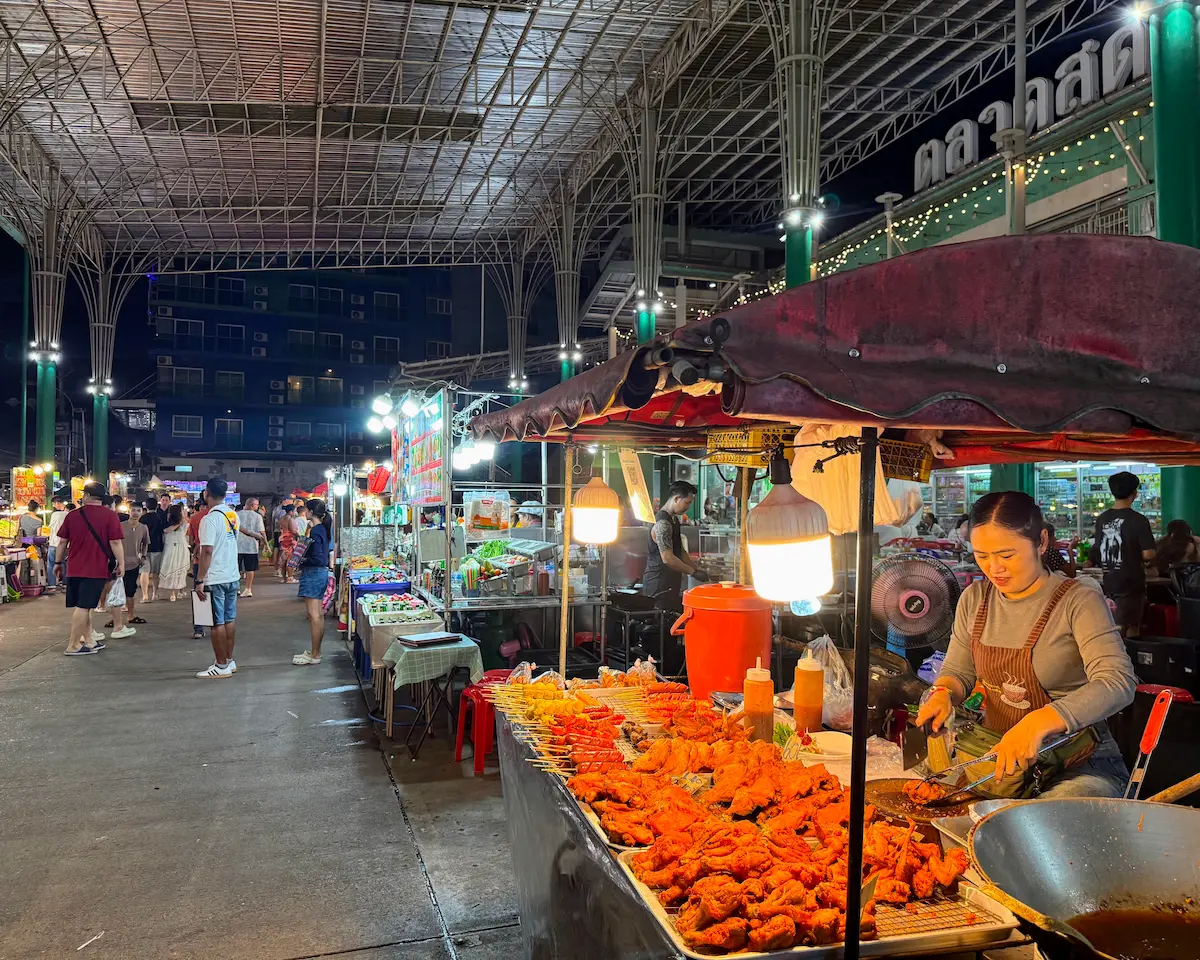
The market spills outward into the surrounding streets, pulling people in gradually through smoke, noise, movement, and light. Even before reaching the main pavilion, there are already rows of small food carts and temporary stalls spread around the outside of the complex, each one competing gently for attention without ever feeling overly aggressive.
The first thing I passed was a row of clothing stalls and small phone accessory shops sitting beneath the glow of fluorescent lights. On one of my earlier visits, I bought a surprisingly good phone case here — one of those small purchases you forget about almost immediately until months later when you realise it somehow became attached to memories of the place itself.
But it’s the food that dominates the atmosphere outside Banzaan Market at night.
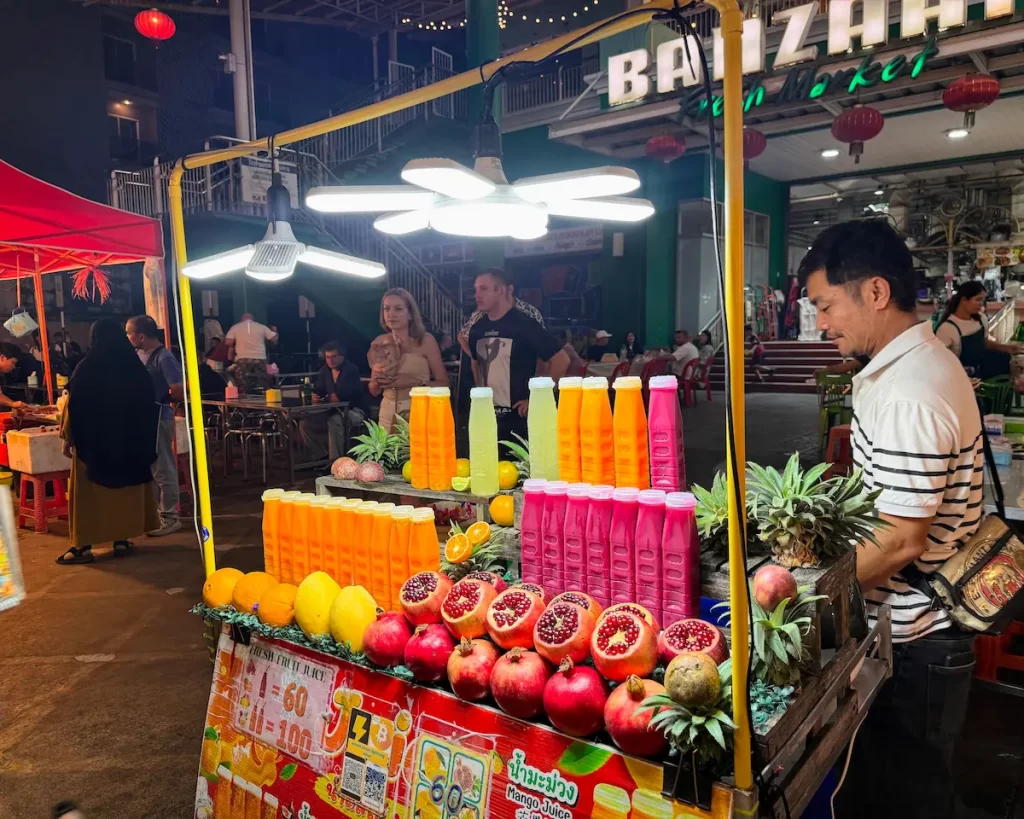
Smoke drifted upward from rows of grills while vendors stood behind hotplates cooking skewers, seafood, pancakes, curries, rotis, fried chicken, and dozens of dishes I still probably couldn’t name properly even after spending so much time in Thailand. Around me were ice cream stalls, alcohol carts, fresh fruit stands, seafood displays packed onto crushed ice, and small Isaan-style stalls selling fried insects lined up neatly beneath bright lights for curious tourists willing to be adventurous.
What I love most is the sheer variety.
Not just the number of stalls, but the feeling that everyone seems to be finding their own version of comfort food inside the market. Some people were sitting down with full seafood platters while others wandered slowly with fruit shakes or grilled skewers in hand. A few tourists cautiously pointed at dishes they didn’t recognise, while nearby locals ordered confidently without even needing to look at the menus.
The atmosphere never feels polished or curated in the way modern food halls sometimes do. It feels layered and slightly chaotic in the best possible way — like dozens of separate kitchens, conversations, smells, and routines all blending together into one shared space.
I decided to eat something small before heading inside the main market building and started slowly wandering between the rows of food carts without any real plan. That’s usually how I end up enjoying places like this most. Not rushing toward a specific restaurant or trying to “tick off” recommended dishes, but simply walking until something catches my attention.
At the front of the market, many of the stalls focus heavily on seafood, with prawns, shellfish, grilled fish, and large displays sitting beneath the lights while vendors fan smoke away from the cooking areas. Nearby were baked potatoes wrapped in foil, sizzling meats cooking over charcoal grills, and trays of curries sitting steaming beneath the heat of the evening air.
One stall I always seem to notice is the shaved ice cream vendor near the entrance to the main pavilion. He works with two metal spatulas against a freezing cold plate, chopping and folding the ice cream mixture in quick rhythmic movements before flattening it thin enough to scrape into delicate rolls. Every few seconds, the sound of the spatulas tapping against the metal plate cuts through the surrounding noise like its own kind of percussion.
It’s strange the small details that stay with you while travelling.
Sometimes it isn’t the landmarks or famous attractions you remember most clearly. Sometimes it’s simply the repetitive sound of metal spatulas echoing through a humid night market in Phuket.
Closer to the entrance of the pavilion were several curry stalls I’ve returned to multiple times now. Usually I still order the same way I did when I first arrived in Thailand — by pointing at whatever looks good and saying, “that one.” Over time, I’ve realised some of the dishes that looked the most unfamiliar at first often turned out to be the ones I enjoyed the most.
Travel slowly changes your relationship with food like that.
At some point, you stop chasing only the dishes every guidebook recommends and start becoming curious instead. Meals become less about safety and familiarity, and more about participation — small moments where you allow yourself to experience a place more honestly.
For me, eating local food has become one of the most enjoyable parts of travelling anywhere.
Not because every meal is extraordinary, but because food often becomes one of the fastest ways to understand the rhythm of a place. The ingredients, the smells drifting through the air, the pace people eat at, the late-night stalls still cooking long after dark — all of it says something quietly important about where you are.
Travel changes your relationship with food slowly over time.
At first, most people stay close to familiarity. The dishes they recognise. The meals they’ve seen online before arriving. But eventually curiosity begins taking over instead. You stop trying to eat “correctly” and start eating based on instinct, smell, atmosphere, and whatever happens to catch your attention in the moment.
That night, I found myself standing near one of the seafood stalls watching fresh oysters being prepared while smoke drifted upward into the humid Phuket air around us. Nearby were trays of seafood resting on ice beneath bright lights while tourists wandered slowly between stalls trying to decide what to order next.
I ordered a few oysters almost impulsively and continued wandering through the market while eating them slowly between stops.
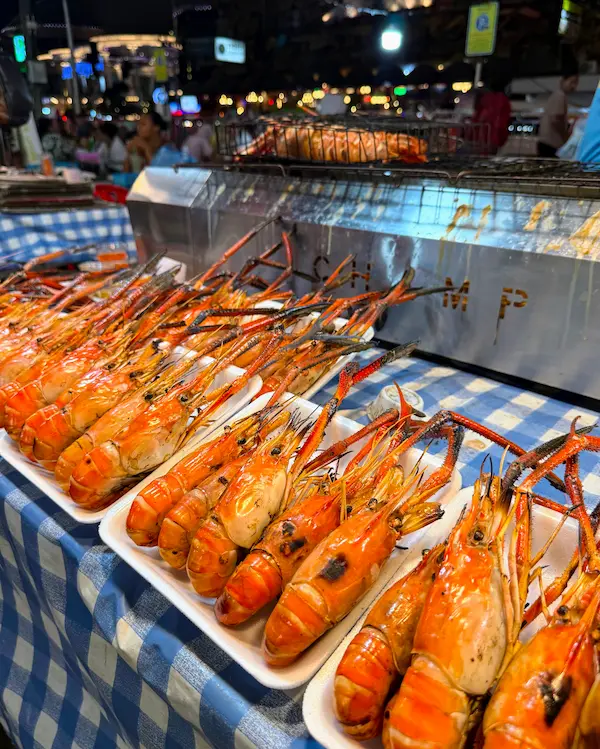 The outdoor food stalls surrounding Banzaan Market create their own atmosphere long before you ever step inside the main pavilion.
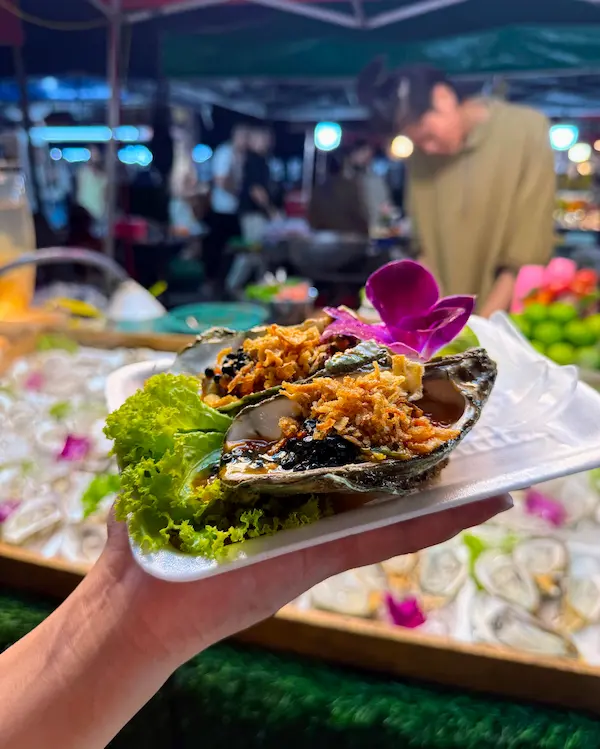 Some travel memories stay with me not because they were planned, but because they captured the feeling of being completely present in a place for a little while.
That’s usually how I end up enjoying places like Banzaan Market most. Not rushing toward a specific restaurant or trying to “tick off” recommended dishes, but simply wandering until something catches my attention naturally.
Nearby, trays of sushi sat displayed at prices that would feel almost impossible back home. A few stalls further along, grilled skewers crackled over charcoal flames while another vendor folded rotis on a hotplate beside stacks of fresh fruit waiting to be blended into smoothies.
Food in places like Banzaan Market always creates that kind of internal debate.
Everything smells good.
Everything looks tempting.
And somehow, even after multiple visits, it still feels impossible to try everything properly.
Inside the Main Pavilion at Banzaan Market
Eventually, still carrying the sticky rice and pork in one hand, I headed toward the main pavilion itself.
There are a few permanent shops surrounding the entrance — a gold shop, a small phone repair store, a handful of quieter businesses that somehow feel disconnected from the energy happening outside — but my attention was already fixed on the market inside.
I’ve always loved walking through markets while travelling, and Banzaan Market is no exception.
There’s something about entering a functioning local market that immediately changes the way you observe a place. Attractions are usually designed to be consumed by visitors. Markets, on the other hand, continue operating whether tourists arrive or not. People are there because they genuinely need to buy vegetables, seafood, fruit, meat, herbs, spices, and ingredients for everyday life.
That difference changes the feeling completely.
As I walked inside, the first section opened into rows of fruit stalls glowing beneath bright fluorescent lights. Mangoes, pineapples, bananas, oranges, dragon fruit, watermelon, and papaya sat stacked carefully in colourful displays beside distinctly Southeast Asian fruits like durian, mangosteen, and rambutan. Some fruits looked instantly familiar, while others still carried a slight sense of mystery even after multiple visits to Thailand.
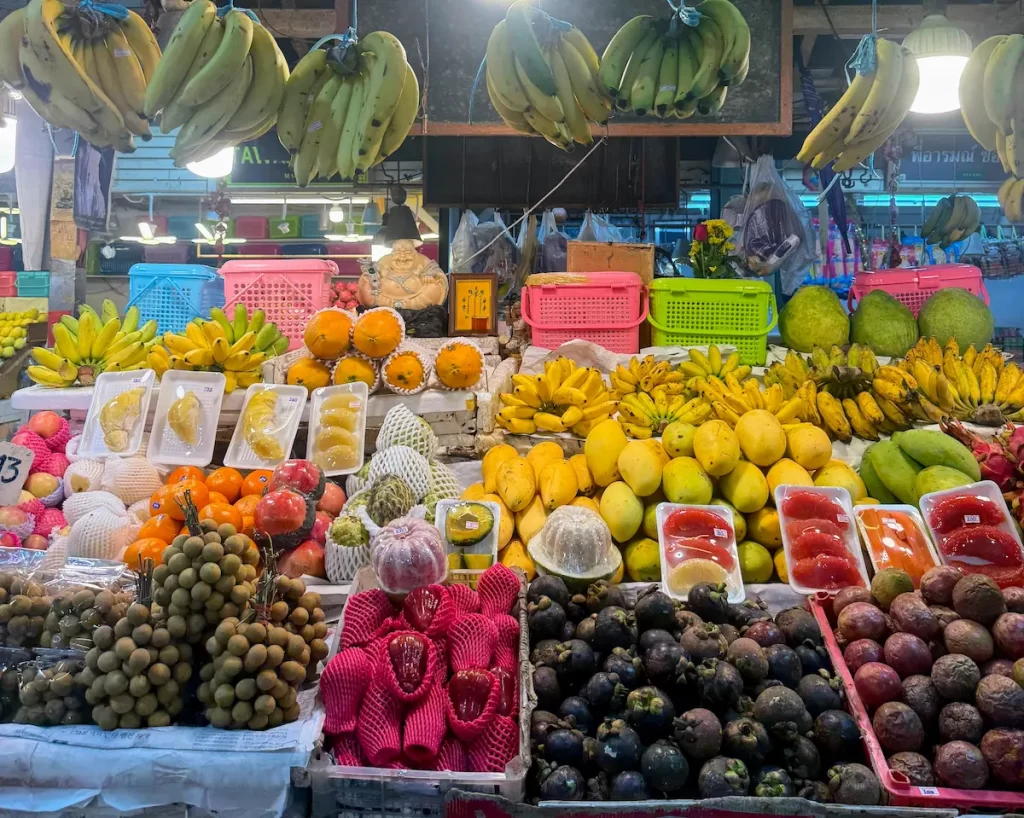
One of the things I’ve slowly realised through travelling is how strongly food becomes connected to memory. Now, even the smell of cut pineapple or ripe mango immediately reminds me of humid evenings in Phuket.
Beyond the fruit section, the market shifted into vegetables and fresh ingredients. Unlike the temporary stalls outside that pack down at the end of the night, the interior of Banzaan Market feels permanent — fixed stalls built into the structure itself, cleaned and reopened again every morning as part of the daily rhythm of Patong.
I had decided earlier that I wanted to make soup back at the guesthouse later that evening, so I began slowly selecting vegetables from different vendors while moving through the aisles. Green onions, mushrooms, herbs, leafy vegetables, garlic, and whatever else looked fresh enough to throw into a pot without overthinking it too much.
A little over 200 baht later, I was carrying far more vegetables than I originally intended.
That seems to happen often in markets.
You walk in planning to buy one or two things and somehow leave carrying enough ingredients to cook properly for days.
What struck me most while wandering through the aisles wasn’t even the food itself, but the sound of the market surrounding it all.
English conversations drifted past Russian conversations. Nearby, Indian families moved between stalls while Thai vendors negotiated prices, called out to customers, or chatted casually among themselves. None of the conversations were individually loud, but together they blended into a layered hum that filled the building continuously.
It reminded me slightly of sitting in a busy hotel reception area where conversations begin quietly at first, then gradually rise into overlapping waves of sound as more and more people arrive.
The floors inside the pavilion were noticeably clean considering how much food moves through the building each day. Workers regularly washed sections down while vendors continued serving customers around them. Still, it remained unmistakably a real market. Some corners carried sweet fruit smells, while others shifted suddenly toward seafood, herbs, raw meat, spices, or unfamiliar scents that seemed to linger briefly before disappearing again.
Markets rarely smell perfect.
But somehow that’s part of what makes them feel authentic.
Places that deal with fresh food, heat, seafood, herbs, and hundreds of people moving through every evening are always going to carry traces of real life with them.
Eventually, vegetables in hand, I wandered toward the seafood section at the far end of the hall.
The transition was impossible to miss.
The smells became heavier almost immediately, and rows of seafood stretched across ice-filled displays under bright lighting — prawns, fish, shellfish, squid, crabs, and sea creatures I still couldn’t confidently name. Nearby sat the meat section, where pork and chicken hung openly behind glass displays or rested on preparation counters waiting to be sold.
One thing that still stands out to me in markets across Thailand is how differently freshness is approached compared to many supermarkets back home. There’s far less emphasis on heavy refrigeration or tightly sealed packaging. Instead, the food feels connected to immediacy — ingredients arriving fresh, being sold fresh, and cooked fresh within the same day.
It feels less industrial somehow.
Less disconnected.
Not necessarily better or worse.
Just different.
And travelling constantly reminds me how many ordinary things we assume are “normal” are often simply the systems we personally grew up around.
While walking through the seafood section, I found myself thinking again about how much markets reveal about a place beyond food alone. They reveal pace, habits, routines, comfort, noise, patience, and the small everyday systems that quietly hold daily life together.
That’s one of the reasons I often end up remembering markets more clearly than tourist attractions.
They feel alive in a way attractions sometimes don’t.
Related reading: Why I Always Notice Markets Before Attractions
Related reading: What Slow Travel Actually Feels Like
Related reading: The Comfort of Familiar Streets in a Foreign Place
Sitting Near the Entrance and Letting the Night Slow Down
By the time I finished walking through the seafood section, the market had started settling into that later part of the evening where the energy changes slightly.
The crowds were still there, but the pace felt softer now.
Some people were arriving for dinner while others were already beginning to leave carrying takeaway bags back toward scooters, hotels, or nearby guesthouses. Vendors continued cooking beneath drifting smoke while the sounds of traffic outside blended constantly into the background like white noise that never fully disappears in Patong.
I realised I wasn’t quite ready to leave yet.
Near the entrance of the pavilion sits a small fixed restaurant area, and instead of continuing to wander, I decided to sit down for a while and simply absorb the atmosphere around me before heading back to the guesthouse.
I ordered a cold Singha beer — partly because it felt appropriate in that moment, and partly because there’s something satisfying about sitting in a Thai market at night drinking a local beer while the rest of the city continues moving around you.
The sticky rice and pork were nearly finished by then, but I kept slowly picking at what remained while watching people drift past the entrance of Banzaan Market.
Some tourists looked overwhelmed trying to decide what to eat.
Others already looked completely comfortable there, moving confidently between stalls they clearly recognised from previous nights. Delivery riders arrived and disappeared again. Nearby vendors stacked ingredients, cleaned counters, or casually chatted while waiting for the next customers to arrive.
And above all of it sat the sound.
That’s what I think I’ll remember most from nights like this.
Not one specific conversation or one particular food stall, but the layered atmosphere created when all the sounds combine together at once.
Traffic passing continuously outside.
Metal pans clattering somewhere nearby.
Scooters accelerating away from intersections.
Distant music drifting faintly from the direction of Bangla Road.
The muffled sounds of commentary and crowd noise floating across from the nearby Muay Thai arena.
Conversations happening in half a dozen different languages at the same time.
The occasional burst of laughter rising above the rest before dissolving back into the market again.
At one point I closed my eyes for a few seconds and simply listened.
Travel sometimes feels strangely rushed now. So much modern travel content revolves around optimisation — where to go, what to eat, how many places to fit into one itinerary, what’s “worth it,” what’s overrated, what needs to be filmed, photographed, reviewed, ranked, or posted online.
But moments like this remind me that some of the best parts of travelling are much quieter than that.
Sometimes the experience is simply sitting still long enough for a place to slowly settle around you.
No major attraction.
No carefully planned activity.
No dramatic moment.
Just the feeling of existing somewhere unfamiliar for a little while until it starts becoming familiar instead.
That’s often when places begin feeling real to me.
Not during the big highlights people usually post online, but during the smaller in-between moments — sitting inside a market after rain, finishing a beer slowly while traffic hums outside, carrying vegetables home to make soup in a guesthouse kitchen later that night.
Those are the moments that tend to stay with me longest.
Eventually the beer was empty, the market was beginning to thin slightly, and the humid Phuket air outside felt cooler than it had earlier in the evening.
So I gathered the bags of vegetables, stepped back out into the noise and lights surrounding Banzaan Market, climbed onto the scooter, and headed back through Patong to the guesthouse.
Snack finished.
Beer finished.
Night drifting quietly toward its end.
And somehow, without really planning to, the evening had become one of those small ordinary travel memories I already knew I’d carry with me long after leaving Phuket.
Related reading: Why Travel Feels Different After Dark
Related reading: The Small Rituals That Make Travel Feel Human
Related reading: The Emotional Side of Leaving a Place
A Few Things People Often Ask
Where is Banzaan Market?
Banzaan Market is located in Patong Phuket near Jungceylon Shopping Centre. You can also find updated information through the official Banzaan Market website.
Is Banzaan Market worth visiting at night?
Yes — the atmosphere changes significantly after dark when the outdoor food stalls, seafood vendors, and night market crowds begin filling the area.
What kind of food is sold at Banzaan Market?
You’ll find seafood, grilled meats, curries, fruit shakes, sushi, Thai street food, desserts, and fresh produce both inside and outside the market.
Is Banzaan Market popular during low season?
Yes. Even during Phuket’s quieter months, the market still attracts both locals and travellers looking for food and evening atmosphere.
About Sonia
Sonia writes reflective travel stories focused on atmosphere, emotion, and the quieter side of experiencing new places. Through evenings in local markets, rainy streets in Phuket, ferry rides, cafés, coastal roads, and slow everyday moments, her work explores what travel actually feels like beyond itineraries and tourist highlights.
Rather than chasing constant movement or “must-see” checklists, Sonia Adventures focuses on the human side of travel — the routines, observations, conversations, and small moments that often stay with us long after a trip ends.
Her writing forms part of the wider Travel With Insight publishing ecosystem, a collection of creator-led travel publications exploring destination experience, modern travel behaviour, and thoughtful travel storytelling through a more grounded and human lens.
Related reading: What Slow Travel Actually Feels Like
Related reading: Why Travel Feels Different After Dark
Related reading: The Emotional Side of Leaving a Place